
Dopamine and the dynamics of subthalamic and leg muscle activities in parkinsonian stepping.
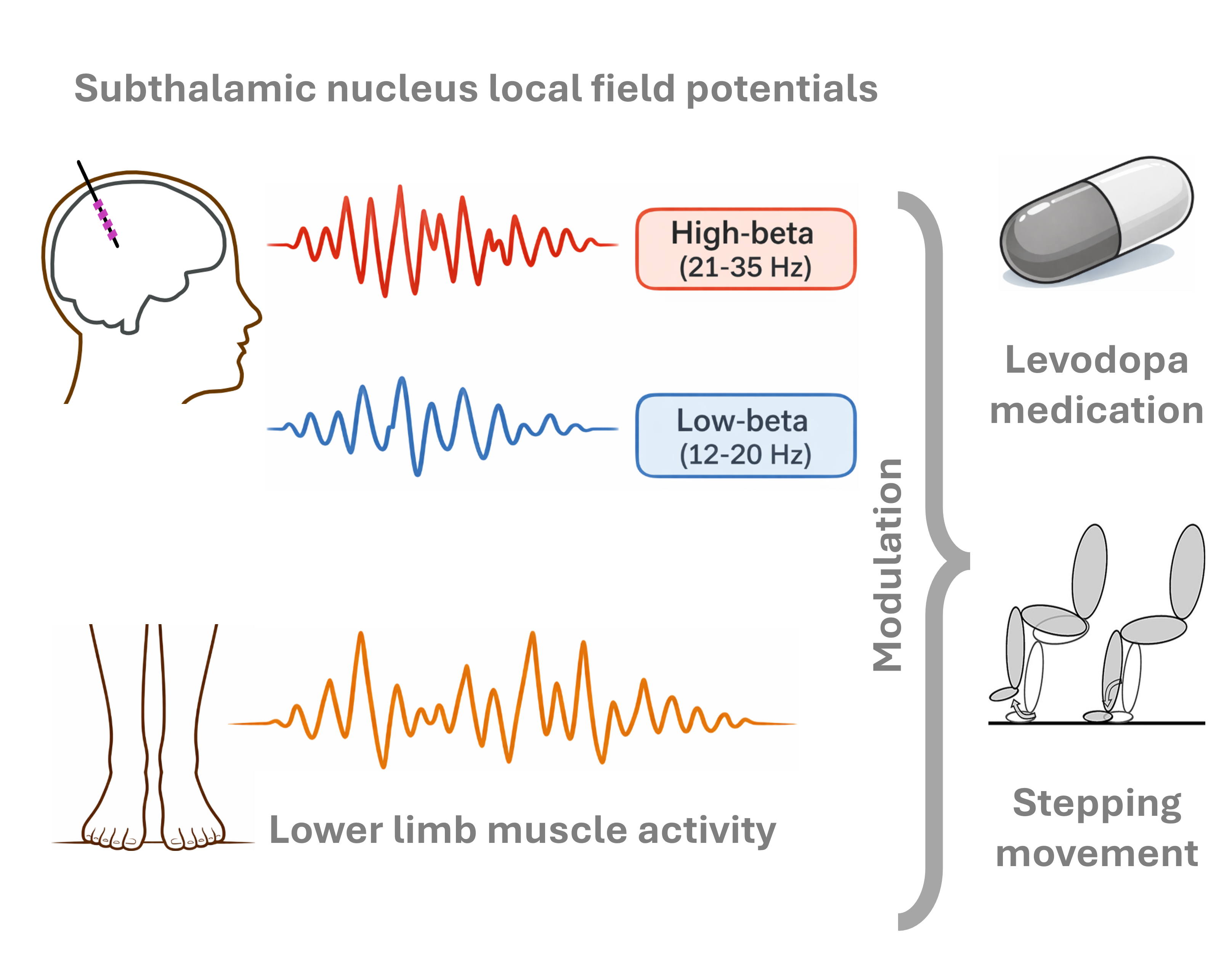
Freezing of gait is a common and disabling problem in Parkinson’s disease that causes sudden difficulty walking and increases falls. This study measured brain signals from the subthalamic nucleus and leg muscle activity while patients sat, stood, or stepped, with and without levodopa. We found that low- and high-beta rhythms change differently with movement and medication, suggesting distinct roles. Levodopa had stronger effects at step initiation, informing step-timed stimulation strategies to improve gait.
Freezing of gait (FOG) is a devastating symptom of Parkinson's disease (PD) often resulting in disabling falls and loss of independence. It affects half of patients, yet current therapeutic strategies are insufficient, and the underlying neural mechanisms remain poorly understood. This study investigated beta oscillation dynamics in the subthalamic nucleus (STN) during different movement states (sitting, standing, and stepping), while examining the effects of levodopa. Specifically, it aimed to identify pathological activity during stepping by analysing the relationship between the STN and leg muscles and how this is modulated by levodopa. Local field potentials (LFP) in the STN and leg muscle activity measured as Electromyography (EMG) of the gastrocnemius and peroneus longus were recorded in 14 PD patients during sitting, standing, and stepping, ON and OFF levodopa. Levodopa reduced stepping frequency variability, implying improved stepping rhythmicity. Low-beta (12-20 Hz) and high-beta (21-35 Hz) were differentially modulated by stepping movements and levodopa, with reduced high-beta and increased low-beta during stepping compared to standing and sitting. In contrast, levodopa reduced low-beta but increased high-beta activity, highlighting a potential physiological function of high-beta in the STN. Additionally, step-phase specific effects of levodopa were observed including reduced broad-beta band activity in the STN and leg muscles during the late stance and lift-off phase of the contralateral leg when ON medication. Furthermore, STN beta bursts were associated with increased muscle activation at movement initiation, potentially reducing the ability to move freely. This study observed different effects of movement status (sitting vs. stepping vs. standing) on the average amplitude of low- versus high-beta frequency bands, suggesting they may serve distinct functional roles. Furthermore, there is a step-phase specific effect of levodopa on STN LFPs, EMGs, and intermuscular coherence during stepping. These findings offer insight for developing phase-specific stimulation strategies targeting STN beta oscillations during gait.
2025. Brain (e-Pub ahead of print).
2025. Mov Disord, 40(12):2641-2653.
2024. J Neurol Neurosurg Psychiatry, 95(12):1112-1122.