
Suppression of pathological oscillations with transcranial focused ultrasound in Parkinson’s disease
In this well-controlled study of people with Parkinson's, the application of non-invasive ultrasound brain stimulation was found to reduce abnormal brain activity linked to the disease and improve movement speed. These early findings highlight the potential of transcranial ultrasound stimulation (TUS) as a new non-invasive therapeutic and scientific tool.
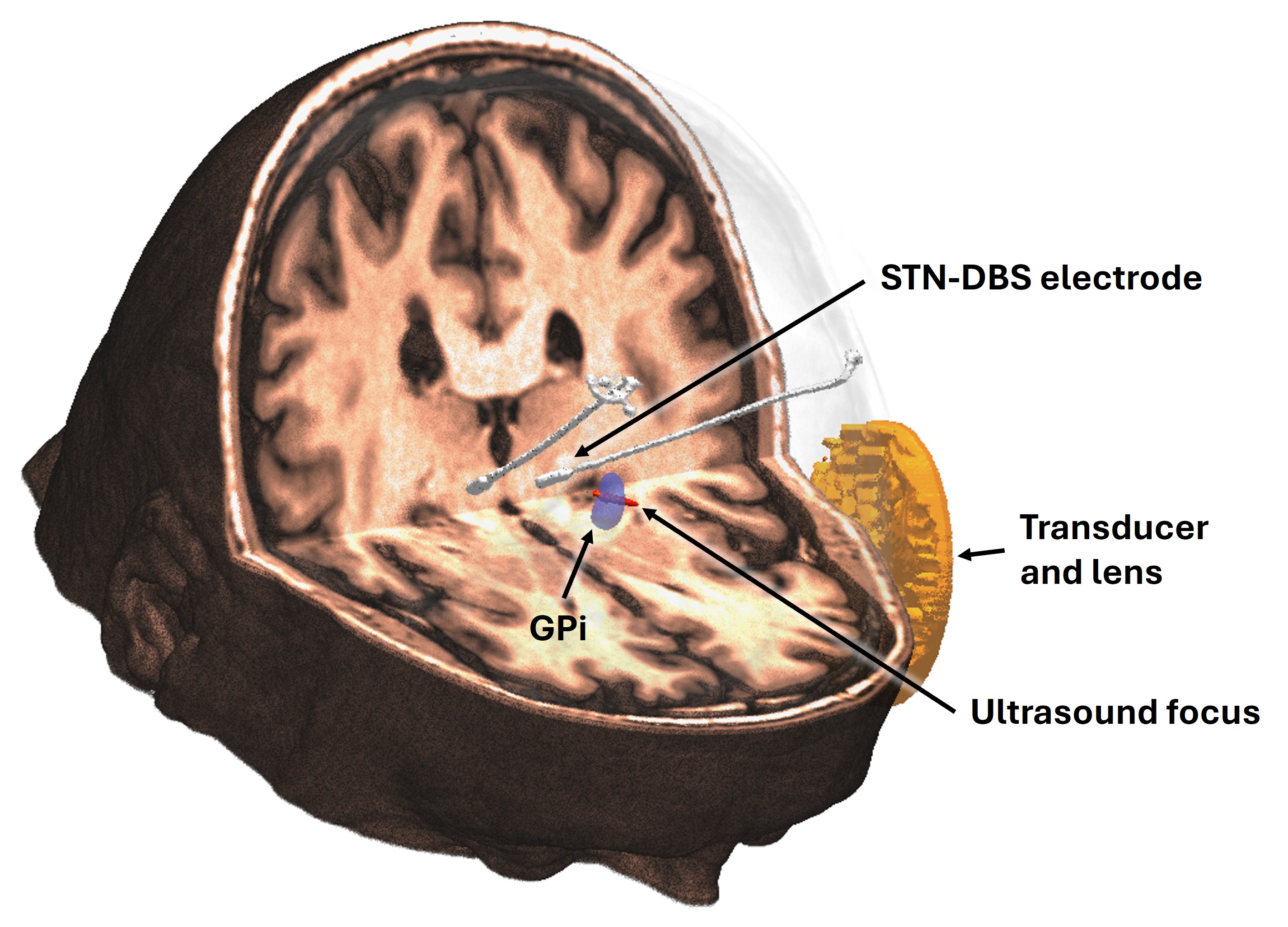
Transcranial ultrasound stimulation (TUS) is an emerging method for non-invasive neuromodulation of deep brain structures. However, to date, there is no evidence that TUS can directly modulate disease-related pathological oscillations in the same direction as known therapies. Inspired by clinical deep brain stimulation, in this randomised controlled cross-over study we probed the effects of pallidal TUS pulsed at 130 Hz on subthalamic beta-band activity, a biomarker in Parkinson’s Disease (PD) in four male participants with PD. Beta-band power reduced in the ipsilateral subthalamic nucleus (STN) by 10.34% (95% CI:3.81% to 16.87%, p < 0.05, false discovery rate (FDR) adjusted). Beta power reduction was correlated between the ipsilateral (R2 = 0.980, p < 0.05, FDR adjusted), but not contralateral, STN and primary motor cortex. Bradykinesia, as measured by change in reaction time, was also reduced by 17.70% (95% CI:8.95% to 26.41%, p < 0.05, FDR adjusted). In this proof of concept study, we demonstrate that TUS can suppress pathological oscillations, potentially opening the door for therapeutic TUS (NCT06932185).
2022. Brain Stimul, 15(6):1513-1516.
2024. J Neurol Neurosurg Psychiatry, 95(12):1112-1122.

2024. Brain Stimul, 17(2):392-394.